Join the movement to end censorship by Big Tech. StopBitBurning.com needs donations and support.
NATO scrambles jets as Swedish leader urges help directing Ukraine’s drones
By isabelle // 2026-05-22
Mastodon
 Parler
 Gab
Gab Copy
Copy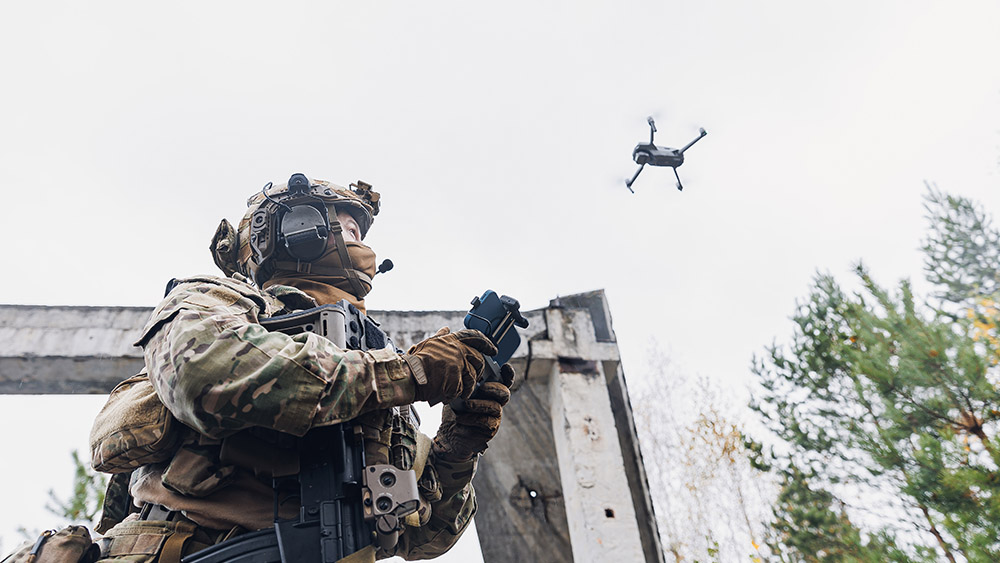
- Ukrainian drones crossing into NATO airspace have triggered a political crisis in Latvia, collapsing its government.
- Swedish Prime Minister Kristersson proposed NATO help Ukraine direct drone attacks, blurring the line between guidance and active participation.
- NATO has scrambled fighter jets multiple times to intercept drones while some members urge Ukraine to keep UAVs away from allied territory.
- Russia warns that assisting Ukrainian drone strikes from NATO soil could be considered an act of war.
- The escalating incidents risk a single miscalculation turning a stray drone into a direct military confrontation between NATO and Russia.
The Kremlin's narrative vs. the ground truth
Russia has dismissed attempts to blame it for Ukrainian drones entering NATO airspace. Moscow argues that the incidents show Kiev is either unable to control its long-range UAVs or is being enabled by neighboring NATO states. The SVR warned that NATO membership will not shield countries that help Ukraine launch attacks into Russian territory. On Thursday, the Russian envoy to the OSCE, Dmitry Polyansky, said that NATO's military activity near Russia's borders has reached Cold War levels. This is not hyperbole. A "stray" Ukrainian drone crashed into the chimney of a power plant in Estonia in late March. This week, a NATO F-16 fighter jet was scrambled to shoot down another UAV. Lithuania has experienced incursions by suspected Ukrainian drones on at least four occasions.Allies urge caution even as NATO planes scramble
The incidents have not been met with universal enthusiasm within the alliance. Poland's Defense Minister Wladyslaw Kosiniak-Kamysz said on Thursday that Ukraine "must be more precise" with its drones, echoing similar warnings from Estonia and Finland. Estonian Defense Minister Hanno Pevkur asked that Kyiv keep its uncrewed aircraft "as far from NATO territory as possible." Yet military realities on the ground suggest precision is becoming harder, not easier. Ukrainian long-range drones have been crossing Baltic and Nordic airspace with increasing regularity since mid-March, targeting oil export infrastructure in northwestern Russia — specifically the Primorsk and Ust-Luga terminals in Leningrad Region. Those intensified attacks are particularly noteworthy amid rising fuel prices triggered by the U.S. and Israeli attacks on Iran. On Wednesday, Lithuania issued air alerts that disrupted air travel and other activity in the capital and led to the president, prime minister, and other senior officials being taken to shelters as a precaution. President Gitanas Nauseda delivered a televised address, calling it an "important lesson" for citizens and institutions. "We must memorize it well," he said, while also cautioning against overreaction or panic.A dangerous game of blame and trigger fingers
The Baltic region has become the proving ground for a new kind of hybrid warfare, one where the line between accident, provocation, and active alliance support for a belligerent nation blurs with each passing drone flight. NATO's response has been contradictory: scramble jets, shoot down drones, and simultaneously pledge to help Ukraine guide its strikes. This is not the Cold War brinkmanship of missile silos and naval blockades; it is something far more chaotic. A single navigation failure, a miscalculated jamming signal, or an overzealous interceptor could turn a "stray" drone into a casus belli. For the people of Vilnius and Riga, the air raid sirens are no longer a drill. They are the sound of a war that refuses to stay on the other side of the border. Sources for this article include: RT.com DW.com NATO.News-Pravda.comMastodon
Parler
Gab
Copy
Tagged Under:
drones NATO Ukraine national security Sweden big government globalism panic chaos dangerous WWIII military tech weapons tech Lithuania Latvia
You Might Also Like


U.S. deported tens of thousands to nations it deems too dangerous to visit, data shows
By Douglas Harrington // Share

Supreme Court Allows Vermont to Proceed With Lawsuit Against Meta Over Age Verification
By Edison Reed // Share

VIPS Memo Warns Against U.S. Military Action in Cuba, Citing Risk of “Catastrophic Failure”
By Chase Codewell // Share

The $6 Billion Strait: Trump’s Final Gambit for Iran Peace or a Pathway to Armageddon?
By Garrison Vance // Share

New defense bill would bind America to permanent Israel military partnership
By Cassie B. // Share
Recent News





Popular This Week