Join the movement to end censorship by Big Tech. StopBitBurning.com needs donations and support.
China draws hard lines ahead of Trump-Xi summit
By isabelle // 2026-05-13
Mastodon
 Parler
 Gab
Gab Copy
Copy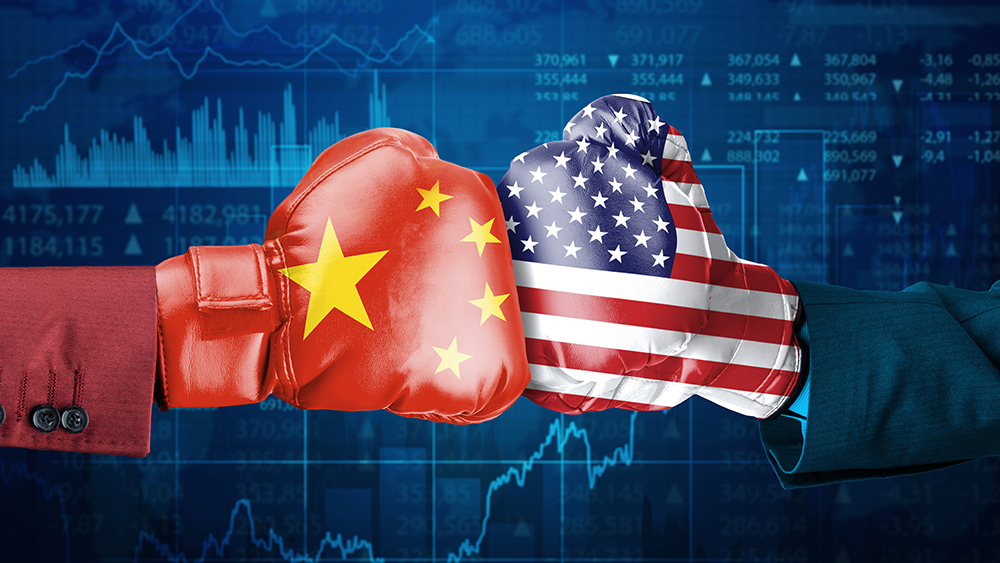
- Trump and Xi prepare for high-stakes Beijing summit amid escalating tensions over Taiwan, Iran, and trade.
- China demands the U.S. respect four "red lines," including Taiwan’s sovereignty and its own political systems.
- U.S. sanctions on Chinese firms over Iran ties complicate talks, as Beijing defies restrictions on Iranian oil imports.
- Trump hints at softening Taiwan support for trade deals, sparking concern among U.S. lawmakers.
- Both leaders seek economic stability but face deep geopolitical divides, with Iran’s war and Taiwan’s status looming large.
Taiwan remains the most explosive issue
China’s insistence on Taiwan as a non-negotiable red line is no surprise. The self-governing island, which Beijing claims as its own, has long been a flashpoint in U.S.-China relations. Trump’s recent comments suggesting he might reconsider arms sales to Taiwan have caused some alarm in Washington. He stated, "President Xi would like us not to, and I’ll have that discussion." "We’re 9,500 miles from Taiwan. He’s 67 miles. It’s a little bit of a difference," Trump remarked, hinting at a potential shift in U.S. policy. This stance contrasts sharply with his first term, when Trump approved significant arms sales to Taipei. Now, with midterm elections looming and economic pressures mounting, some fear he may soften America’s support for Taiwan in exchange for trade concessions. "The way you respond to a China flex is with a flex," warned Sen. Thom Tillis (R-N.C.), urging Trump to push back against Beijing’s assertiveness.Iran war casts a shadow over talks
The U.S.-led conflict in Iran has added another layer of complexity. China, while publicly calling for peace, has continued purchasing Iranian oil despite American sanctions. The U.S. Treasury recently blacklisted Chinese oil refineries accused of purchasing Iranian oil, while the State Department sanctioned Chinese satellite firms accused of supplying imagery to aid Iranian military strikes. Trump has oscillated between praising Xi’s diplomatic efforts and criticizing China for not doing more to rein in Iran. "I think he’s been relatively good, to be honest with you," Trump said before departing. Yet, just days earlier, he threatened a 50% tariff on Chinese goods over reports that Beijing was supplying Iran with air defense systems—a claim he later walked back after receiving what he called a written assurance from Xi.Trade truce in question
Both leaders have reason to avoid escalating tensions. Last year, the U.S. and China teetered on the brink of a full-blown trade war, with Trump imposing 145% tariffs on Chinese goods and Beijing retaliating with rare-earth export controls. A fragile truce was reached in October, but the Iran conflict has since disrupted global supply chains, hurting China’s economy as much as America’s. Trump’s administration is now prioritizing stability over confrontation. Treasury Secretary Scott Bessent, a former hedge fund manager, has taken the lead in summit preparations, signaling a focus on economic cooperation over security disputes. Yet, hawks in Congress remain skeptical. "China needs to stop being a personal trainer for our adversaries," Tillis said, referring to Beijing’s support for Iran and Russia.A summit of managed expectations
With both leaders grappling with domestic challenges—Trump’s sagging approval ratings and Xi’s economic slowdown—neither side appears eager for a major confrontation. Instead, the summit may yield modest agreements on artificial intelligence, fentanyl precursor controls, and trade facilitation. Nevertheless, the underlying tensions remain. China’s red lines on Taiwan and human rights clash with America’s strategic interests, while the Iran war continues to strain global markets. For Trump, the summit is an opportunity to reset relations with a key economic rival while navigating the fallout from the Iran conflict. For Xi, it’s a chance to assert China’s growing influence without provoking further American retaliation. The decisions made in Beijing this week will shape not just U.S.-China relations, but the future of global stability. Sources for this article include: RT.com APNews.com WashingtonPost.comMastodon
Parler
Gab
Copy
Tagged Under:
Taiwan Iran China national security Trump Xi Jinping big government globalism WWIII future tech trade war
You Might Also Like
Trump: U.S. Will Seize or Destroy Iran’s Enriched Uranium Stockpile
By Garrison Vance // Share
China Raises Fuel Price Caps Again as Iran War Keeps Oil Markets on Edge
By Garrison Vance // Share
Why China Is Winning the AI Race (and Why America May Never Catch Up)
By Mike Adams // Share
Strait of Hormuz remains effectively blocked as NATO, Iran tangle over shipping security
By Willow Tohi // Share
Tense Trump-Netanyahu phone call suggests widening disagreement over Iran strategy
By Zoey Sky // Share
U.K. Eases Some Russian Oil Sanctions as Fuel Prices Soar
By Sterling Ashworth // Share
Recent News




Popular This Week